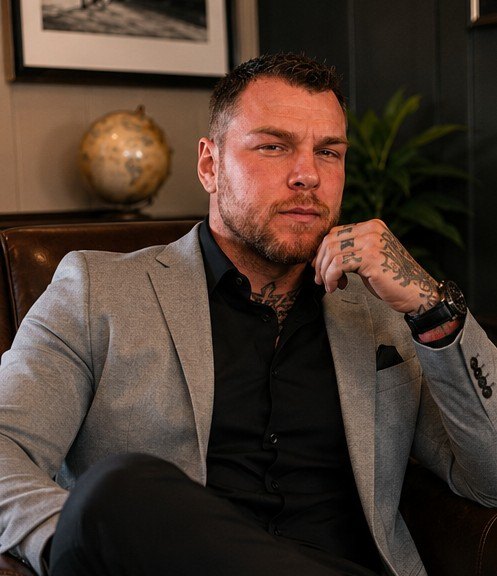
15+
Years in trades & construction
3
Client builds delivered
5
Ventures in motion
Chapter one · No language for it
A kid struggling in an era that
had no words for it.
I grew up in a time when mental health wasn’t accepted as a way of life. The science was out there — ADHD, PTSD, depression, anxiety, neurodivergence, all of it — but none of it was recognized at anyone’s kitchen table. Psychosis got noticed. Struggling quietly didn’t. So a kid who was struggling had no words for what was wrong, and neither did anyone around him.
I was intelligent enough to read the world and navigate it anyway — which meant I came across as abrasive instead of as a kid who was drowning. The intelligence was camouflage. I left home at fourteen. Couch to couch, out of province for a stretch, back home a few times over the next ten years. It never took.
Nobody got invested in me. Not in who I was, why I was, what I felt. That’s the wound underneath everything that came after.
Chapter two · The hands
Fifteen years understanding how things
actually get built.
When you’re on your own that young, you work. I became a construction foreman and a concrete finisher — fifteen years of it. Concrete doesn’t care how good your drawings look — it sets in about four hours, in whatever shape you managed, and then it’s honest forever. You learn how things actually get built, not how they look on paper. You learn to see the load-bearing wall in everything.
That ground-level systems thinking never left. It’s in every site I ship and every venture I run.
Chapter three · The wrong classroom
The first people who ever invested in me
were in a jail cell.
At twenty-three, a stupid driving charge got me a weekend sentence — in Friday, out Monday, for about six months. The entry-level way of doing time. Over those weekends I met men who were connected, in the life. And they did something nobody else ever had: they paid attention. They invested in me.
I’d been lonely my whole life, so that’s where I learned to be a man — aggressive, toxic, anti-establishment. That’s the lesson the system actually teaches. Within a year, the ladder started: six months. Six months. Three months. Eight months. Six months. Three years. Four years.
And the deepest point: I spent four years of my life with a needle in my arm. I’m not going to dress that up, because dressing it up is the opposite of the point.
Chapter four · The slow burn
"You can’t torture a blind man into understanding how to paint." Punishment never taught me anything. It took fifteen years to dig the hole — there was no snapping my fingers to climb out.
About seven years ago I talked my family into letting me come home to the farm. They remember that stretch as traumatic, chaotic — a failure. They didn’t know what it was measured against. Coming from where I’d been, it was a major step up. The same stretch was a disaster for my family and a turning point for me. Both are true.
I decided I wanted my life together. With nobody to talk to, it took years — I didn’t know what questions to ask or who to ask. The last time inside, I used it differently: I got educated. Business, marketing, management, finance. A teacher talked me into taking an IQ test. Turns out the hardware was never the problem. I’m on the spectrum, high-functioning, with metacognition that doesn’t shut off — which means I can’t stop seeing patterns. In anything. Ever.
Chapter five · Somebody listened
Not a program. Not a sentence.
One man who listened.
On my last sentence, I got connected to the Bridges to Community program — a John Howard Society initiative that helps people coming out of the system build an actual life on the outside. One of its managing members sat down across from me. He listened. He genuinely believed in me. He told me the dreams were actually feasible — and then started opening doors to prove it.
That’s the pivot of this entire story, and it’s worth saying exactly: what changed my life wasn’t a punishment or a policy. It was one person who treated my ideas as real. Priorities shifted. Purpose showed up. Everything on this site exists downstream of somebody finally listening.
Chapter six · The pattern
The pattern I see every single day, everywhere I look, is the suffering the system unintentionally orchestrates: people falling through the same cracks on a loop — a self-fulfilling prophecy where suffering feeds more suffering.
Being immersed in that kind of toxic, friction-based life for so many years made me acutely aware of friction wherever it shows up — any demographic, any business, any system. I can’t help seeing it now, because I lived in my version of it for so long. My story is the far end of the spectrum — I got about as bad as you can get, and most people never get anywhere near that far. But the frictions that took me there aren’t rare at all.
Our world is structured to be difficult on purpose — gates and hoops built so nobody takes advantage of anything — and that same structure quietly punishes any development, individuality, or personal progression that doesn’t fit inside the boxes. Everybody’s life is individual and everybody’s struggle is their own — I’m not diminishing anyone’s suffering — but so much of it traces back to those same structures, the same locked doors. It all translates. A lot of it speaks the same language.
All these politicians understand compound interest. Well — compounding trauma works the same way.
Add it up: eight and a half years of my life in jail — all of which could have been averted by a little bit of life coaching, a sandwich, and a fucking hug. My life could have been different. And that’s the case for so many of the people in there.
Most people learn to look away. I’ve spent years cataloguing it instead. Which door failed. Which form assumed a lawyer filled it out. Which waitlist quietly meant "no." Most come out of hardship broken. I came out with a blueprint.
Chapter seven · The blueprint
That catalogue became
Pillar Incentive.
A venture studio is a company that builds companies. Mine runs on two engines. Engine one pays the bills: websites, brands, systems, and AI automation for business clients — three builds delivered and counting. Engine two is why the studio exists: the ventures. Roughly half get built to sell — the exits feed the machine. The genuinely impactful ones stay under our roof permanently, so nobody can ever corrupt or dilute what they’re for.
The Yes I Can Initiative is the fix for everything I catalogued — eighteen doors, one navigation engine, built by someone who’s lived the problem. Incarcerated Canada exists because families get handed a different rulebook at every institution, and somebody who’s seen that from the inside should be the one keeping the file.
Chapter eight · What I’m building toward
The past is only here to make the future
credible.
Who am I building for? My nieces and nephews. The kids in my life. I’m building so that if somebody I love ever gets into trouble, the system doesn’t chew them apart the way it did me. That machine is still running, and it catches kids like I was every single day.
And that’s exactly what the ventures are — each one is a piece of this story, fixed. The Yes I Can Initiative exists because I didn’t know what questions to ask or who to ask — so I’m building the thing that asks for you: eighteen doors, one system, whether you’re leaving prison, aging out of foster care, or fleeing violence at home. Incarcerated Canada exists because families like mine got handed a different rulebook at every institution. Clicket turns money-can’t-buy experiences into dollars for registered charities. Even HONEY — a voice assistant my grandpa can reach on the farmhouse landline — comes from the same conviction: nobody should be left to navigate alone.
Twenty years out, the world I’m working toward comes down to two words: access and transparency. I build systems that give people leverage they’re currently denied. That’s the whole studio in one sentence — and it’s why the mission ventures stay under our roof, where nobody can dilute what they’re for. I’m innovating the future to wage war on poverty and pain.
Because the world I actually see is one where people are tuned in and informed enough — with enough real community in their lives — that making good, responsible decisions isn’t even a choice anymore. It’s just the way things are. There’s no reason we can’t get there if we all put our heads together.
And I’m at peace with the scale of that. I might just be the stepping stone. I don’t need to see the fruits of my labour — as long as I did something good, and made the right change to help change the world.
Chapter nine · What it means for you
If you’re a client, here’s what the story buys you: the same eye that catalogues system cracks finds your dead loops, your missed dollars, the thing everyone in your business stopped noticing three years ago. I do it inside every build whether anyone asks or not. Sometimes it’s the most valuable part.
The hardest problems get solved by people who’ve lived them. Every build carries that as the load-bearing wall.